

Buffing Pad & Tool Info
With 170 patents worldwide, Lake Country is an industry leader in the innovation of polishing products, pads and accessories. For decades, we have continued to raise the bar and evolve to fit the needs of our constantly growing and changing market.
We’d all love to have an infinite stock of brand-new buffing pads, but in reality, we’re going to need to clean and re-use. Using the Lake Country System 4000® Pad Washer will improve your efficiency, since you can clean and continue without leaving your project. If that’s not an option, be sure to keep a stack of fresh pads at the ready, so you’re well-prepared for the next task. If you’re correcting a family sedan, you should expect to need more than 5 cutting pads and at least 2 finishing pads. You can never have too many!
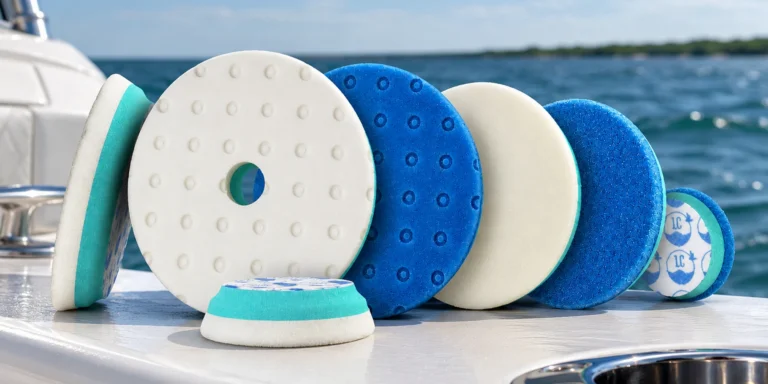
Polishing pads are different colors to distinguish the different types of foam and aggression/application levels. Some of our most recent buffing pad lines contain new colors not previously used in the industry as a standard measurement of aggression. These colors are unique to the LC brand. Learn more about LC’s aggression rating system on our Pad Technology page.
The best buffing pad for your project is the pad that strikes the right balance between cut (how aggressively it can remove paint material) and refinement (how little haze or dullness it might leave behind). Harder paints and deeper defects will call for a more aggressive pad, so you’re not wasting time and doing too little work. Fine swirls or soft paint surfaces require a gentler approach, so you don’t over-shoot the target and remove more paint material than necessary.
It’s all about abrasion! Cutting describes the use of a polisher, pad and liquid abrasive to remove paint material. The term is generally used when talking about more aggressive end pads for removing scratches, swirls and other prominent defects. The coarseness involved at this stage may leave behind a certain amount of haze or dullness. Finishing is still technically cutting (using a polisher, pad and liquid abrasive to remove paint material), but normally finishing describes a much finer scale of abrasion to restore a clarity and gloss that the heavier cutting stages can’t.
Microfiber is a more modern option. The increased surface area of the fibers allows for the face of the pad to carry out more work on the paint surface, so ultimately they can offer higher levels of cut than a foam. But there are pros and cons. For example, the fibers have a tendency to clog and may need more regular cleaning than a foam pad would. You may prefer one over the other depending on your style, but the go-to among many pro detailers today would be a microfiber for cutting, then a foam for final finishing work. Learn more about the science behind microfiber, foam and other buffing pad materials.
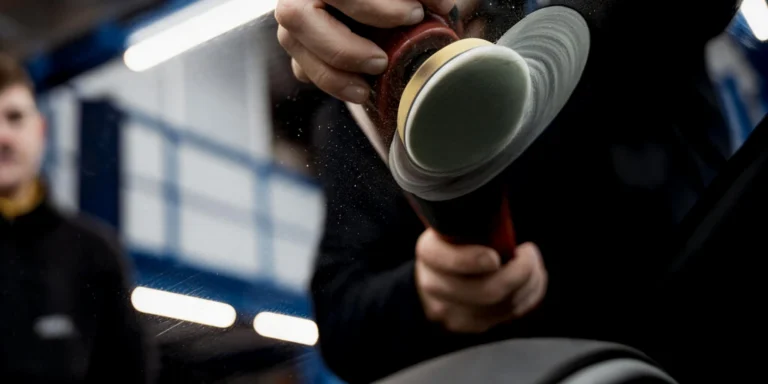
Random orbital polishers have the broadest range of abilities, are safest to use and can create the best possible gloss, but a skilled detailer tackling very heavy defects might want to try a rotary polisher for ultimate cutting efficiency.
Buffing pads are rated from 1 to 10, according to two functions:
- First is the cutting ability, which is how aggressively the buffing pad will remove a defect.
- Second is the finishing capability, which is how well the buffing pad will be able to refine its own abrasion (from the cutting phase) to create a purer gloss.
Some buffing pads are highly abrasive (aggressive) and will remove a defect quickly, but the trade-off for that efficiency is that they leave the surface dull or hazy. Pads at the opposite end of the polishing spectrum lack cutting ability, but their primary function is to refine the surface, leaving the highest gloss possible. The many buffing pads in between ensure that Lake Country has the right pad available for you, whatever buffing or polishing challenge you face.
Learn more about aggression and buffing pad technology or download our Master Aggression Chart.
Buffing Pad Care
Due to the many variables at play, it’s difficult to give a solid single answer. Proper cleaning, handling and storage are important, as is making sure you’ve chosen the right buffing pad for the task. Think of your buffing pads like tires; they will “wear out” faster if abused. Your pads will suffer if you’re using constant high-speed, high-pressure techniques trying to make them outperform their intended function, or if you’re running them over/against sharp, unmasked edges. If a buffing pad’s performance has finally dropped off to a point that it’s significantly slowing you down, it’s time for the trash.
Find buffing pad care instructions for cleaning and maintaining your pads according to their material. Generally, we recommend the Lake Country System 4000® Pad Washer for cleaning on the go. However, if you don’t have one yet, you can use the old-fashioned method (water, mild dish soap, lots of kneading by hand and thorough rinsing). Alternatively, you can put Lake Country pads in the washing machine (wash in cold on a gentle cycle). Always allow your buffing pads to air dry thoroughly before storing them neatly in a sealed, clean container.
In our System 4000® Pad Washer, we recommend Snappy Clean Boost™. However, if you don’t have a pad washer, you can use the old-fashioned method (water, mild dish soap, lots of kneading by hand and thorough rinsing). Alternatively, you can put Lake Country polishing pads in the washing machine (wash in cold on a gentle cycle). Always allow your pads to air dry thoroughly before storing them neatly in a sealed, clean container. See our buffing pad care instructions for help cleaning different pad materials.
Absolutely, yes! Your polishing pads just need to be cleaned regularly to keep them performing well.
Purchasing
We have a diverse group of industrial, OEM and detailing distribution partners that sell our premium buffing pads and accessories. Find a retailer near you.
Explore our global network of dealers, distributors and retailers on our Where to Buy page.
Distributors
If you’re interested in becoming a Lake Country Manufacturing distributor, please call 262-367-8395 or contact us online. To learn more about the benefits of selling LC products, visit our For Distributors page.
Private label
Yes, we offer private label options that suit a host of needs for distribution partners. Our buffing and polishing pads can be privately labeled with custom on-product or packaging graphics. We offer creative custom solutions that work for your market. View our partnership levels and contact a member of our team to learn more.
Explore More Product Resources
Lake Country Catalog
Download our full catalog of buffing pads, accessories, pad cleaning products and more.
Master Aggression Chart
Compare each of our buffing pad materials and their cutting and polishing abilities.
Buffing Pad Care Instructions
Proper maintenance for different materials keeps buffing pads working better, longer.
Events & Training
Explore our events and training sessions to develop expertise in buffing pads and polishing.


Join TheinnerCircle
Sign up to receive updates about product launches, training opportunities, technical insights and company news.
"*" indicates required fields